Real Estate · Free
Haus & Hearth
A warm architectural real-estate page: split-screen listing showcase with a draggable before/after-style divider, terracotta and plaster palette.
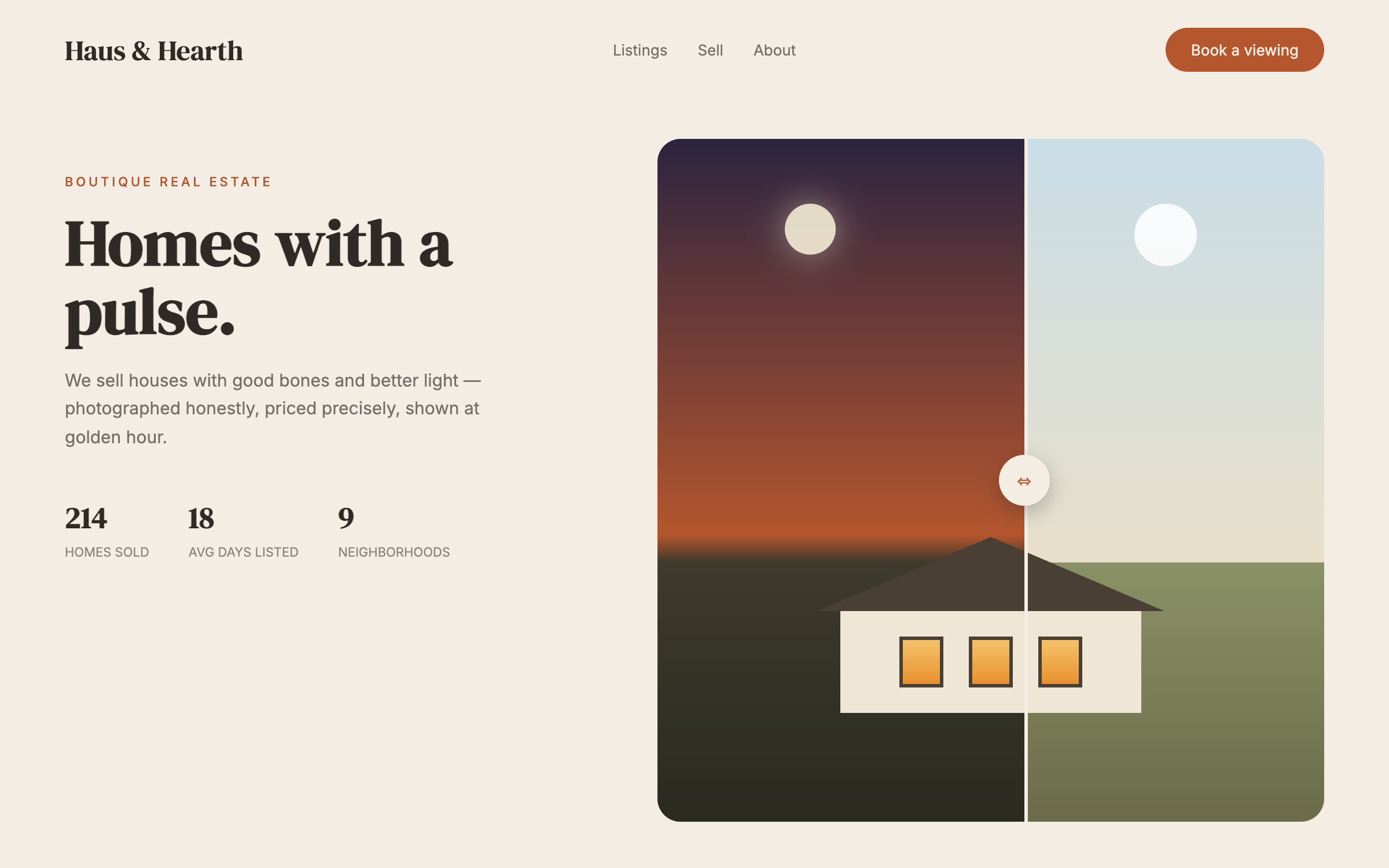
DM Serif Display + InterWarm architectural, split-screen slider
prompt.txt — paste as your first message
You are designing the site of a boutique real-estate studio. Build a complete one-page site for a fictional agency called Haus & Hearth ("Homes with a pulse."). Copy is editorial and specific — rooms, light, streets — no "dream home" filler, no lorem ipsum.

ART DIRECTION — warm architectural. Plaster background #F3EDE4, espresso ink #2F2A25, terracotta accent #B4562E, a supporting olive #6B6B4A for tags. Listing "photography" is faked in CSS: each property card is a composed gradient scene (a warm two-tone gradient with a horizon line and a sun disc or window shape in translucent white) — abstract, architectural, consistent. Fonts via Google Fonts: "DM Serif Display" for headlines and prices, "Inter" for body and data. Mood: architecture magazine.

LAYOUT, top to bottom:
1. Nav — serif wordmark "H&H", links (Listings, Sell, About), terracotta "Book a viewing" pill.
2. Hero — SPLIT SCREEN: left half is copy (eyebrow, big serif headline, sub, CTA, and a small stat row: homes sold, avg days, neighborhoods); right half is a tall CSS scene of a house facade at dusk with a vertical DIVIDER HANDLE the visitor can drag left/right to shift the scene from "day" to "dusk" (two layered gradient scenes, the top one clipped by the divider position; a labeled round handle with arrows).
3. Featured listings — three cards: CSS scene, serif price, address line, three mono-ish specs (beds, baths, sqft) separated by dots, an olive neighborhood tag, "View →" link.
4. The difference — a 2×2 grid of short promises (Honest pricing, 3D-first viewings, One agent start to finish, No listing left stale) with thin terracotta rules.
5. Sold strip — a horizontal scroll-snap row of five compact sold cards, each stamped "SOLD" at a slight angle with final price.
6. Valuation band — espresso background, cream serif question ("What is your home worth now?"), inline mini-form (address field + terracotta button; on submit show a friendly "We'll call you within one business day" note — no backend claims).
7. Footer — office address, license line, quiet links.

MOTION: the hero divider follows pointer drag (and touch), with a gentle ease when released; if untouched for 4s it auto-sways once as a hint; cards lift 4px with shadow on hover; serif prices count up on first reveal; sections fade-rise via IntersectionObserver. Respect prefers-reduced-motion: divider static at 50%, no sway.

RULES: responsive at 375 / 768 / 1280 (hero stacks — scene above copy on mobile, divider still draggable via touch; sold strip stays horizontally scrollable inside its own container). Semantic HTML, labeled form field, focus states, body contrast at least 4.5:1. All art is CSS gradients and inline SVG — no images, no libraries. Complete without JavaScript (divider simply rests at 50%).
Why these prompts work
Every template follows the same five-part structure, so the result is consistent every time:
01
Role + output contract
What to build and the quality bar — no lorem ipsum, real copy.
02
Art direction
Exact hex palette, Google-Fonts pairing, and mood keywords.
03
Layout spec
Section by section, top to bottom — nothing left to chance.
04
Motion spec
Entrances, scroll reveals, hovers, and timing curves.
05
Rules
Responsive breakpoints, accessibility, and what the AI must not do.
Works great for
Each industry page carries this style pre-tailored — your services, prices and palette already written in: